A Carte Visa Classique at La Banque Postale costs between €35 and €130 per year, depending on the tier. That fee hits your account regardless of how often the card sits unused in a drawer.
Most guides treat La Banque Postale like an obvious first stop for newcomers to France. The application itself is straightforward enough. But the pre-requirements, documentation loops, and account-opening friction trip up the people who need the card most.
This article is for expats, international students, and anyone recently arrived in France who needs a French credit card and keeps running into walls they did not expect.
The Account-First Requirement That Slows Everything Down
La Banque Postale ties every credit card to a current account (compte courant). No account, no card. And opening that account is its own process, separate from the card application entirely.
Opening a La Banque Postale Account as a Non-French Resident
Applicants can start online through the La Banque Postale portal, but first-time account holders almost always need an in-branch visit for identity verification.
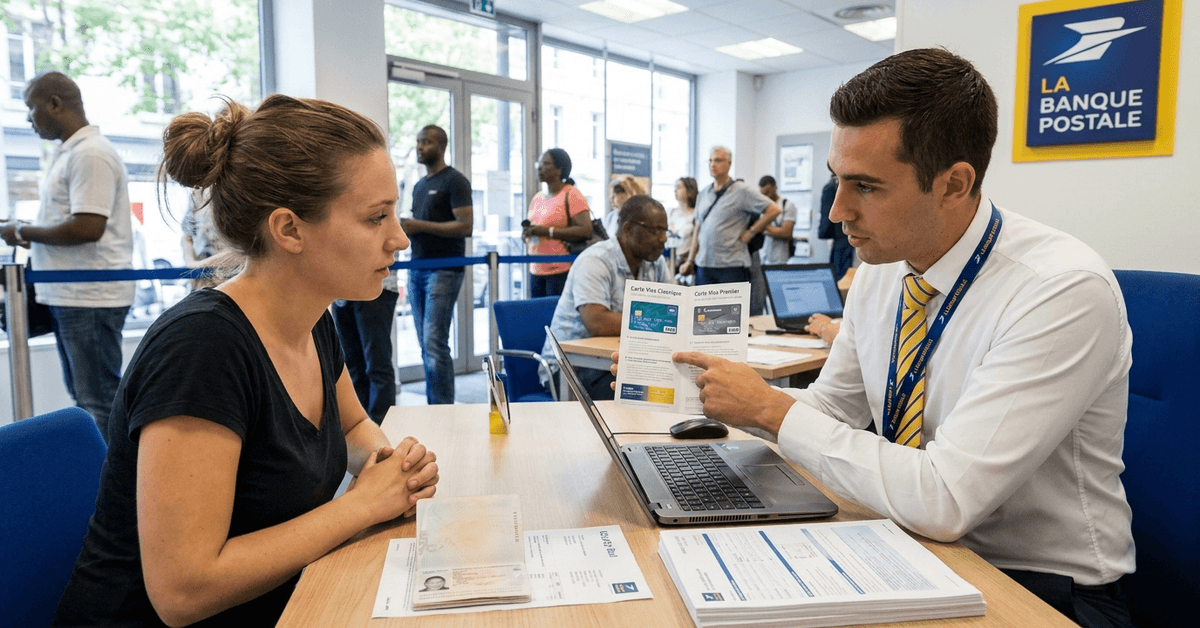
That means booking time at a local bureau de poste, bringing original documents, and waiting for processing.
The branch visit can feel redundant if you have already submitted everything digitally. But La Banque Postale still requires face-to-face ID checks for new clients, and this step alone can add a week to the timeline.
Documents That Trip Up New Arrivals
The paperwork list looks simple on the surface. But each item has a catch for someone who just moved to France:
- Government-issued photo ID: passport works, but a titre de séjour may be requested separately
- Proof of address: a recent utility bill or rental contract, which new arrivals often do not have yet
- Recent pay slips: three months of French income, a problem if the job just started
- Tax notice (avis d’imposition): unavailable during the first year of French tax residency
Self-employed applicants face an extra layer. Recent business account statements or tax returns (liasse fiscale) may be requested, and the bank’s definition of “recent” is not always clear.
I would skip the online-only route entirely for a first application at La Banque Postale. The in-branch process, while slower, tends to catch documentation gaps early instead of bouncing the application back two weeks later with a vague rejection email.
Which La Banque Postale Card Matches Which Situation
Three card tiers cover most use cases, but the differences between them are smaller than the marketing suggests.
The Carte Visa Classique handles daily purchases, contactless payments, and international acceptance. The Carte Visa Premier adds travel insurance, higher spending limits, and emergency assistance abroad.
Specialized cards for students and young adults exist with lower income thresholds or no income verification at all.
| Feature | Carte Visa Classique | Carte Visa Premier | Youth/Student Card |
|---|---|---|---|
| Annual fee range | ~€35-€45 | ~€80-€130 | Often reduced or waived |
| Contactless payments | Yes | Yes | Yes |
| Travel insurance | Basic or none | Included | Limited |
| Income requirement | Stable income needed | Higher income threshold | Low or none |
| Spending limits | Standard | Higher | Lower |
The Premier card’s travel insurance is the main differentiator. If travel is not a regular part of the picture, the Classique does the same job for half the annual cost.
The Student and Youth Card Catch
Cards marketed to students at La Banque Postale often require a parent or guardian co-signature if the applicant is under 25 and has no independent income.
That co-signer typically needs to be a La Banque Postale account holder too, which creates a second application process running in parallel.
Credit Evaluation: How La Banque Postale Decides
French banks do not use a single FICO-style score the way American lenders do. La Banque Postale reviews each application individually, looking at existing debts, payment history on the current account, and income stability.
The Fichier National Problem for Newcomers
The Banque de France maintains a registry of banking incidents (Fichier Central des Chèques and FICP). La Banque Postale checks this registry during the application review. Newcomers without any French banking history show up as blank entries, and a blank file is not the same as a clean file in the eyes of the credit team.
I think the widely repeated advice to “just apply and see what happens” misses something at La Banque Postale specifically. A blank Banque de France file combined with less than three months of account history on a La Banque Postale compte courant makes approval unlikely for anything above the basic Classique tier.
Running the account for three to six months first, with regular deposits and no overdrafts, builds a visible track record the credit team can read.
What Triggers Extra Scrutiny
Several situations can slow down or complicate the review:
- Recent address changes, especially multiple moves within a short period
- Employment contracts shorter than 12 months (CDD vs CDI matters here)
- Non-EU residency status, which triggers additional document requests
- Limited or no prior French banking relationship
The review itself takes anywhere from a few days to two weeks. Silence during that window usually means the file is still being processed, not that something went wrong.
Fees and Interest Rates: Read the Conditions Générales
Annual fees are the obvious cost. Less obvious are the charges buried in the conditions générales de tarification, the fee schedule booklet that arrives with the account opening paperwork.
Cash withdrawals at non-La Banque Postale ATMs may carry a per-transaction fee. Late payments generate penalties. Foreign currency transactions include a conversion markup that varies by card tier.
Promotional fee waivers for new clients sometimes appear, but they typically expire after the first year without notice.
I would check the conditions générales line by line against a competitor like BNP Paribas or Société Générale before committing. The annual fee difference between banks is often less than €10, but the cash withdrawal and foreign transaction charges can vary by 50% or more.
After Approval: Activation and the Separate PIN
The card arrives by mail at the registered address. A PIN code ships in a separate envelope, usually a few days later. This two-envelope system is standard in French banking and means the card cannot be used immediately upon arrival.
Activation happens online, in-branch, or by phone, depending on the branch. Some branches still require a physical visit to activate, which adds another trip to the post office.
Spending behavior during the first few months matters. La Banque Postale reviews new cardholders’ usage patterns, and consistent, responsible use can lead to credit limit increases or eligibility for the Premier tier later.
Overdrafts or missed payments in the first quarter, on the other hand, can freeze upgrade options for 12 months or longer.
Comparing La Banque Postale to Other French Banks
The application steps at BNP Paribas, Société Générale, and Crédit Agricole look almost identical. Eligibility thresholds are similar. The real differences hide in three places:
- Digital experience: online-only banks like Boursorama or Fortuneo skip the in-branch requirement entirely
- Fee structures: neobanks often waive annual card fees but charge for services La Banque Postale includes
- Insurance coverage: Premier-tier cards at traditional banks tend to include better travel insurance than digital bank equivalents
La Banque Postale’s strongest card is familiarity. Post offices exist in almost every French commune, and walk-in access to a human advisor still matters when paperwork gets complicated.
For someone comfortable managing everything digitally, the in-branch requirement is a friction cost with no upside.
Questions People Ask About La Banque Postale Credit Cards
These questions come up constantly in expat forums and rarely get straight answers.
- Q: Can a non-EU resident apply for a La Banque Postale credit card?
Yes, but expect additional document requests. A valid titre de séjour, proof of French address, and French-source income documentation are typically required. Processing may take longer than for EU nationals. - Q: How long does La Banque Postale credit card approval take?
Between a few days and two weeks after submitting a complete application. Incomplete documentation is the most common cause of delays. Calling the branch after 10 business days is reasonable if there has been no update. - Q: Does La Banque Postale offer credit cards without a current account?
No. Every credit card must be linked to a La Banque Postale compte courant. The account must be opened and active before the card application can proceed. - Q: Are La Banque Postale credit card fees negotiable?
Annual fees on standard tiers are generally fixed, but promotional waivers for the first year appear periodically. Asking at the branch during account opening is the most common way to find out about current offers. - Q: Can students get a La Banque Postale credit card without income proof?
Some youth cards require no income verification, but a parent or guardian co-signature is usually needed for applicants under 25. The co-signer often needs their own La Banque Postale account.
Conclusion
La Banque Postale credit cards work well for people who want a traditional French bank with physical branches everywhere. The application process rewards patience, preparation, and a willingness to show up in person.
Expats who run their current account cleanly for a few months before applying save themselves the most frustration. Start the account first, then let the card follow on its own timeline.