
A 0% introductory APR sounds generous until you read what the rate jumps to after 15 billing cycles. Bank of America prints that number in the terms disclosure, and most first-time applicants never check it.
The card comparison pages rank rewards and sign-up bonuses. They rarely mention that the post-intro APR on some Bank of America cards can climb above 25%, turning that “free financing” period into an expensive habit if a balance lingers.
This walkthrough is for the person filling out their first credit card application in 2026, probably sitting on a thin credit file and wondering which Bank of America card to pick without wrecking their approval odds.
Does a Bank of America Card Fit a First-Time Applicant?
Bank of America runs one of the wider card lineups among major U.S. issuers: cash rewards, travel points, secured cards, and student-specific options.
That range can work in a new applicant’s favor because the same issuer offers a path from starter card to premium product down the line.
But the range also creates confusion. A first-timer might see the Customized Cash Rewards card, get excited about the 3% category bonus, and apply without realizing that card generally requires good to excellent credit. A denial dings the credit report and wastes the hard inquiry.
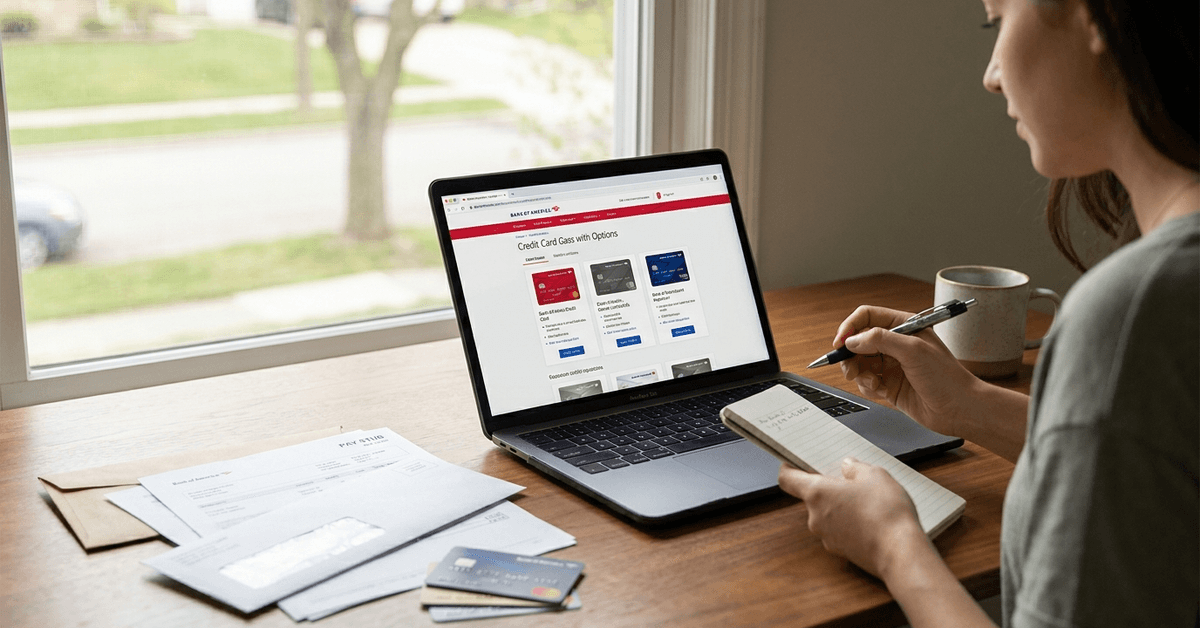
Secured Cards and the Refundable Deposit
The BankAmericard Secured Credit Card asks for a refundable security deposit, and that deposit sets the credit limit. The minimum deposit tends to start around $300.
I think the secured card route gets dismissed too quickly by applicants who could qualify: the deposit comes back after consistent on-time payments and a credit line review, usually within 12 months of responsible use.
Secured cards report to all three bureaus the same way unsecured cards do. The credit-building effect is identical. So the deposit is a temporary cost, not a permanent one.
Student Cards and Enrollment Proof
Bank of America’s student card option may ask for school name, enrollment status, or proof of enrollment.
The eligibility bar is lower than a standard rewards card, but the applicant still needs a Social Security Number or ITIN and a U.S. address. P.O. boxes don’t count.
APR, Fees, and the Numbers That Change After Month One
Every Bank of America card publishes an annual percentage rate, but first-time applicants tend to fixate on the introductory number and skip the ongoing rate. Those two numbers can differ by 15 percentage points or more, depending on creditworthiness.
The Introductory APR Trap
Some cards offer 0% APR on purchases for a set number of billing cycles. That period is useful for a planned expense: furniture, a laptop, an emergency repair. The trap springs when the applicant treats it as a spending runway instead of a repayment window.
Once the intro period expires, interest accrues on any remaining balance at the regular purchase APR.
I would tell anyone using a 0% intro period on a Bank of America card to divide the total purchase price by the number of intro months and automate that payment. Missing even one month of that schedule compounds fast.
Annual Fees and Transaction Costs
Not every Bank of America card carries an annual fee. The secured card and several cash-back options charge $0 per year. Travel-oriented cards sometimes carry fees in the $95 range, though a few waive the fee for the first year.
Look at these fee categories before applying:
- Balance transfer fees: typically 3% to 5% of the transferred amount, with a minimum dollar floor
- Foreign transaction fees: some cards charge around 3% per international purchase, while select travel cards waive this entirely
- Late payment fees: up to $40 per missed payment, and a late payment reported to credit bureaus can drop a score significantly
The fee math matters more than the rewards math for someone carrying a balance. A 2% cash-back rate on $5,000 in annual spending returns $100. One late fee and a rate penalty can erase that in a single billing cycle.
How the Bank of America Application Process Works in 2026
The application itself takes less time than most people expect. The online path at Bank of America’s credit cards page walks through each field, and the system gives many applicants an instant decision.
Documents and Details to Gather First
Pull these together before opening the application:
- Current home address and how long the applicant has lived there
- Employer name, job title, and annual income (including side income and investments)
- Monthly housing payment, even a rough estimate
- Social Security Number or ITIN
One step most first-timers skip: pulling a free credit report from AnnualCreditReport.com before applying. Errors on a credit report are more common than people assume, and disputing an incorrect late payment or a duplicate account before the application goes in can shift the outcome.
The Application Steps
The online form at Bank of America starts with card selection. Filters sort by category: rewards, travel, credit building. After picking a card, the applicant clicks “Apply Now” and enters personal and financial information.
Double-checking entries matters. A mistyped income figure or an address that doesn’t match the credit file can trigger a manual review, which slows the process from instant to days.
After submission, three outcomes are possible:
- Instant approval: the screen shows the credit limit, card details, and next steps. A physical card arrives by mail within 7 to 10 business days.
- Pending review: the bank needs extra verification. This might mean a phone call or a request for documents. It does not mean denial.
- Denial: Bank of America sends a written adverse action notice explaining which credit factors drove the decision.
What to Do the Day the Card Arrives
Activation is the obvious first step, but the less obvious moves in the first 30 days set the tone for the account’s entire history.
Set Up Alerts and Autopay
The Bank of America mobile app lets cardholders set transaction alerts by dollar threshold, transaction type, or location. Turning on push notifications for charges above $50 catches unauthorized use early.
Autopay is the single most effective tool against late payments. Setting it to the full statement balance each month eliminates interest charges entirely. Setting it to the minimum payment at least prevents the late fee and the credit bureau ding.
Building Credit the Boring Way
I think the advice to “use your card for everything to maximize rewards” is wrong for a first-time Bank of America cardholder carrying a limit under $2,000.
Keeping utilization below 30% of the credit limit has a measurable effect on credit scores, and on a $1,000 limit, that means spending no more than $300 before paying down. Chasing 2% cash back on a $50 grocery run while pushing utilization to 80% is a losing trade.
The boring approach: put one recurring subscription on the card, set autopay to full balance, and let the account age. Credit age and payment history carry more scoring weight than rewards optimization.
Rewards and Bonus Categories Worth Checking
Bank of America’s rewards structure varies by card. The Customized Cash Rewards card lets the holder pick a 3% cash-back category (gas, online shopping, dining, travel, drug stores, or home improvement). The base rate on everything else is 1%.
Preferred Rewards is Bank of America’s tiered loyalty program. Customers who hold a qualifying balance across Bank of America and Merrill accounts can bump cash-back and points earnings by 25% to 75%.
Sign-up bonuses on certain cards require minimum spending within the first 90 days. Read that threshold carefully. A $200 bonus that requires $1,000 in spending within three months is reasonable. A $300 bonus requiring $3,000 is a stretch for someone who doesn’t spend that much naturally, and manufacturing spending to hit a bonus defeats the purpose.
Privacy Settings and Terms Most Applicants Ignore
The application includes consent to Bank of America’s privacy policy. During or shortly after enrollment, the applicant can adjust marketing preferences and limit how the bank shares data for advertising purposes.
The cardholder agreement spells out rate-change triggers, penalty APR conditions, and dispute procedures.
Even a five-minute read of the rate table and fee schedule before agreeing saves confusion later. Penalty APR, for example, can push the rate well above 29% after a serious delinquency.
Questions People Ask About Bank of America Credit Cards
These questions come up constantly among first-time applicants, and the answers tend to be scattered across different pages.
- Q: Can I get a Bank of America credit card with no credit history?
The secured card is designed exactly for this. The refundable deposit sets the credit limit, and the card reports to all three bureaus monthly. After roughly 12 months of on-time payments, the account may be reviewed for an upgrade to an unsecured card. - Q: Does applying for a Bank of America card hurt my credit score?
A hard inquiry typically lowers a score by a few points and stays on the report for two years. The effect fades within a few months for most applicants. Applying for multiple cards in a short window stacks those inquiries. - Q: How long does Bank of America take to approve a credit card?
Many applications get an instant decision. Pending reviews can take a few business days, sometimes up to two weeks if the bank requests additional documentation. - Q: What credit score do I need for a Bank of America rewards card?
Rewards cards generally require a score in the good to excellent range, roughly 670 and above. Secured and student cards have lower thresholds, though Bank of America does not publish a hard minimum. - Q: Can I upgrade my Bank of America secured card later?
After a period of on-time payments and responsible use, Bank of America may offer a product change to an unsecured card. The deposit is returned when the upgrade goes through.
Conclusion
A Bank of America credit card can be a solid starting point for a thin credit file in 2026. The secured card path costs a deposit upfront but builds the same credit history as any unsecured card.
Checking a free credit report before applying catches errors that could cost an approval. Pick the card that fits current spending, not the one with the flashiest bonus.